

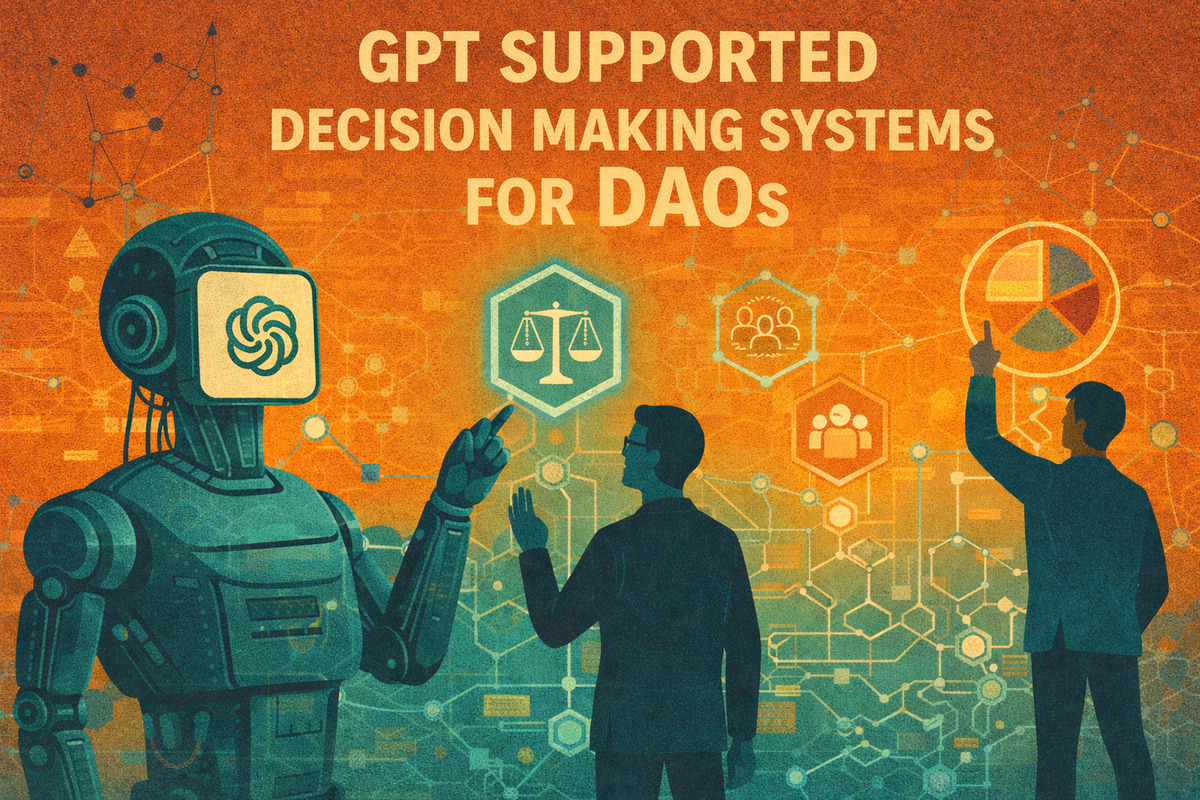
Decentralized Autonomous Organizations (DAOs) have emerged as one of the most ambitious experiments in the blockchain world. The idea of non-hierarchical governance, transparency, and community-based decision-making has offered a strong alternative to traditional institutions. However, in practice, as DAOs grow, they face a new challenge: decision-making complexity. In structures with hundreds, sometimes thousands of participants, making healthy decisions is not as easy as it seems. At this point, GPT-based artificial intelligence systems stand out as a new “decision support layer” for DAOs.
In this article, we will discuss the decisionmaking problem of DAOs and GPT supported decisionmaking systems. Let us first examine what a DAO is. For more articles and indepth analysis on Web3 and GPT related topics, visit https://www.web3gpt.io.
What Is a DAO?
DAO (Decentralized Autonomous Organization) refers to digital organizations in which governance is not held by a single person or institution, but by the community, and whose rules are defined through code on the blockchain. In these organizations, decisions are made through voting, rules are transparent, immutable, and there is no need for intermediaries. In short, a DAO is a digital organization governed by its community.
The Decision-Making Problem in DAOs
The fundamental promise of DAOs is that every member can participate in governance. However, this democratic structure can produce certain problems over time. Some of these include the increasing number of proposals, prolonged forum discussions, technical texts that are difficult for everyone to understand, and low participation rates. In many DAOs, decisions are shaped by a small minority who actually review the proposals. This leads to a result that contradicts the spirit of decentralization.
Moreover, in matters that require technical expertise, it becomes difficult for nonexpert members to vote consciously. At this point, the problem is not the number of participants, but access to information and the ability to interpret it.
So, What Is a GPT-Supported Decision System?
A GPT-supported decision system is a decision support mechanism that uses artificial intelligence (GPT) to help people make better and more informed decisions. In short, a GPTsupported decision system is not the one that makes the decision, but an AI that makes the decision easier to understand.
What Do GPT-Supported Decision Systems Offer?
GPTbased systems aim to support decision-making processes in DAOs rather than automate them. The goal here is not for artificial intelligence to make decisions, but to help people make better decisions. These systems can analyze hundreds of comments shared in DAO forums, summarize long discussions, and gather different viewpoints under clear headings. In this way, a member can grasp the essence of a discussion in just a few minutes instead of spending hours reading messages. This makes everything more understandable.
Are Emotions Also Part of the Process?
Most DAO decisions are not only technical but also emotional. How the community feels about a proposal is at least as important as technical accuracy. GPTsupported sentiment analysis systems can extract the general mood of the community from written feedback. For example, a proposal may be technically sound, but if it creates distrust within the community, this can be detected at an early stage. This makes a layer that is often overlooked in governance visible: collective emotion.
Is Information Inequality Also a Problem? YES.
One of the common problems encountered in DAOs is information inequality. Over time, a natural gap forms between core teams who have technical expertise and members who possess more general knowledge. This situation makes it difficult for everyone to participate equally in decisionmaking processes.
GPTsupported systems can reduce this gap by transforming complex and technical documents into simpler, more understandable, and summarized forms. In this way, not only experts but more members can take part in the decision-making process by truly understanding what they are voting on.
As a result, this approach contributes to DAOs becoming more democratic and inclusive structures not only on paper but also in real life.
Can GPT Vote? NO.
There is a critical line here: GPT systems should not vote. Allowing artificial intelligence to gain direct governance power is contrary to the essence of decentralization. However, roles such as guidance, analysis, and summarization strengthen human agency.
GPT’s role should not be that of a “decisionmaker,” but rather an “intelligent advisor.” Final responsibility must always remain with humans.
How Reliable Is It?
GPTsupported decision systems also bring ethical questions with them. Which data is being analyzed? Which perspective does the AI prioritize? Do the datasets it is trained on truly reflect the values of the community?
If these systems are not transparent, the risk of unnoticed manipulation may arise. Therefore, it is critically important that GPT models used in DAOs are clearly defined, auditable, and updatable by the community.
As a result, GPTsupported decision-making systems for DAOs have the potential to reduce complexity, which is one of the biggest challenges of decentralized governance. However, this potential depends on how and for what purpose artificial intelligence is used. GPT exists not to make decisions on behalf of humans, but to make them more understandable, accessible, and informed.
When used correctly, these systems enable more people to participate in governance, reduce information inequality, and make decision-making processes more transparent. When designed incorrectly, however, they can weaken decentralization instead of strengthening it.Therefore, the real issue is not technology, but balance. Artificial intelligence should not turn into an authority; it should remain a tool that supports the collective intelligence of the community. If this balance can be maintained, GPT supported DAOs can open the door not only to more efficient but also to a fairer and more inclusive governance model.
Contributed by GuestPosts.biz