

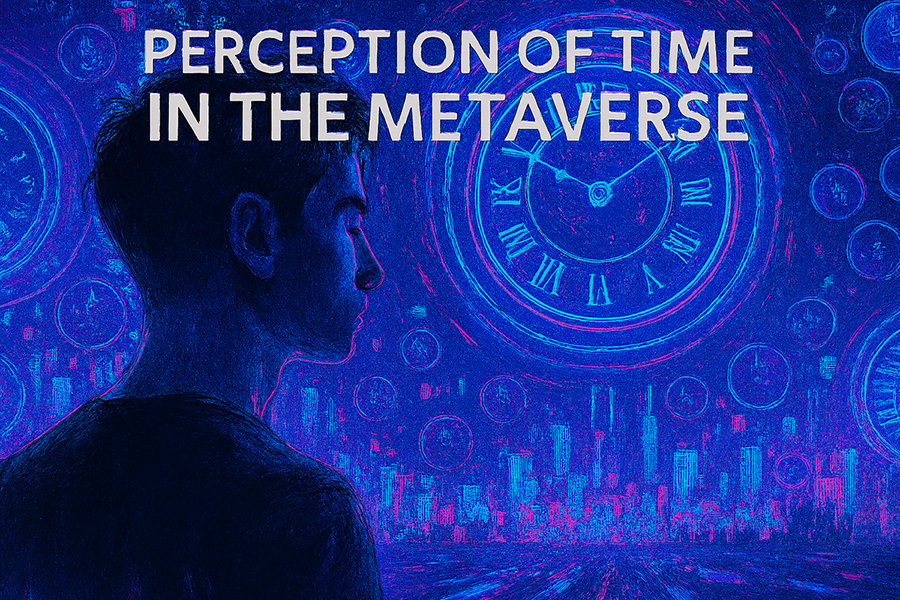
Time is one of the strangest perceptions of the human mind. Sometimes minutes stretch like hours, while at other times hours melt away within a few minutes. Metaverse and virtual reality experiences do not merely affect this perception; they almost reshape it. When you put on a VR headset, your connection with the clock in the real world breaks; time begins to be measured not by a calendar, but by the intensity of experience.
This is not a coincidence. The metaverse directly interacts with the mechanisms in the human brain that form the perception of time. So why does time feel different in virtual worlds, and what kind of lasting effects does this have on our minds? In this article, we will discuss these topics.To explore more insights on the metaverse, AI, and emerging technologies, visit Meta-Shapers.
How Does the Perception of Time Form in the Brain?
There is no single center for time in the human brain. The perception of time emerges through the combination of attention, memory, emotions, and environmental stimuli. The brain does not measure the passing of time; it counts what happens. The more stimuli there are and the more intense the experience, the perception of time is shaped accordingly.
Metaverse environments address exactly this point. Visual, auditory, and even tactile stimuli are activated at the same time. The brain perceives this intensity as more experience and recalculates the flow of time accordingly.
Why Does Time Feel Different in VR?
The main reason time seems to speed up in VR experiences is that attention becomes completely locked onto a single point. In the real world, there are many factors that distract our attention: notifications, environmental sounds, physical needs. In VR environments, however, most of these stimuli disappear.
The brain almost receives the following message“I am only here right now.”
This state of complete focus is known in psychology as the “flow” state. In a flow state, the perception of time weakens. Metaverse experiences deliberately trigger this state. As a result, users may spend hours without realizing it.
This effect is not limited to entertainment purposes; it also causes time to be perceived differently in areas such as education and simulation.
What Are the Effects of Long-Term Use?
The metaverse bending the perception of time may be impressive in the short term. However, in long-term use, this situation can lead to certain mental consequences. First of all, frequent VR use conditions the brain to high levels of stimulation. The real world is slower and less stimulating compared to virtual environments. This creates risks such as a feeling of boredom with the real world, impatience, and intolerance toward low-stimulation environments.
The constant acceleration of time perception can increase the feeling that “there is not enough time” in daily life. When the brain cannot find the intensity it is accustomed to in the metaverse within the real world, it begins to perceive real time as insufficient.
Effects on Concentration and Attention
The metaverse can paradoxically both strengthen and weaken attention. In short-term and purposeful use, VR environments support deep focus. This is a major advantage, especially in education and skill development.
However, with long and uncontrolled use, the attention system can be harmed. Because the brain begins to expect constant high stimulation. For example, it makes it harder to focus on long texts, lowers motivation in daily tasks, and shortens attention span. In other words, the metaverse can be a gym that strengthens the attention muscle, but when overused, it can also become a source of stress that exhausts it.
Reprogramming the Mind
One of the most interesting effects of the metaverse is its potential to permanently reshape the perception of time. The mind adapts to the rhythm of the environment in which it spends the most time. For this reason, individuals who remain in virtual worlds for long periods may experience changes over time in their perception of speed, level of expectation, and patience threshold.
This does not necessarily have to be a “distortion.” Properly designed metaverse experiences can increase time awareness, accelerate learning processes, and strengthen attention control. The problem lies in how this power is used and for what purpose.
Time Is Not the Owner, but a Technological Tool
Reprogramming the perception of time brings great responsibility. Metaverse platforms should offer experiences that maintain balance, rather than consuming users’ attention and time resources without limits. On the user side, awareness is of critical importance. Moments when we fail to notice how time passes are not always pleasant. Sometimes, this indicates that control is slipping out of our hands.
So, who controls time in the end? We do.
The metaverse is a powerful tool that stretches, accelerates, and transforms our perception of time. While virtual worlds reprogram our minds, the real question is this: Do we determine the rhythm of time, or do virtual universes?
The answer to this question will determine whether the metaverse becomes a space of freedom or a mental trap in the future.
Contributed by GuestPosts.biz